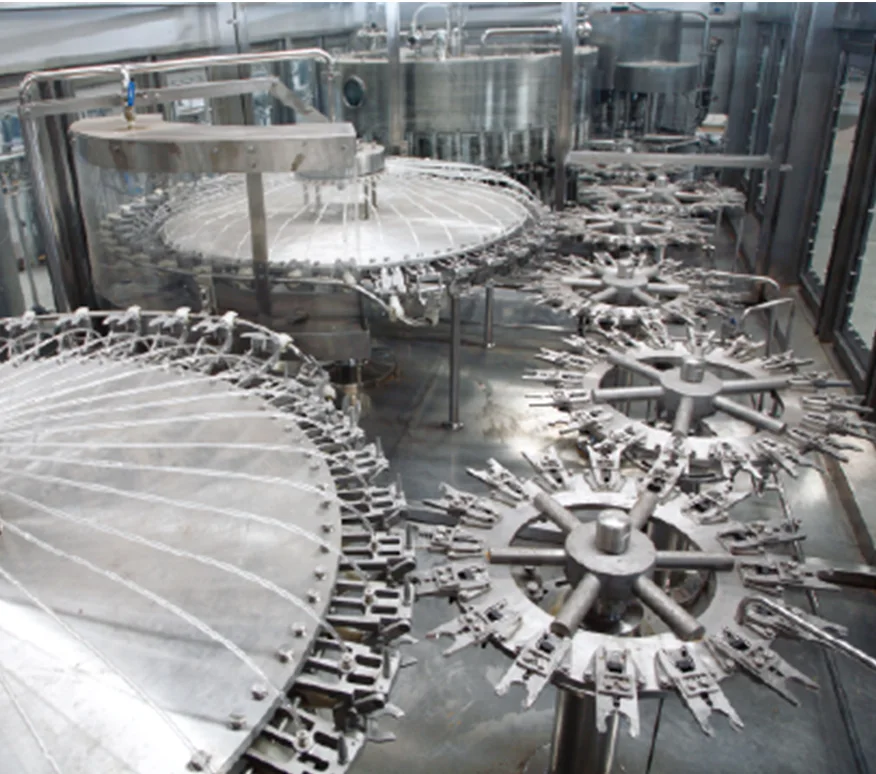

Most quotes for a non-carbonated water bottling machine look the same on page one: “3-in-1 washing, filling, capping” plus a nominal speed in bottles per hour. Where two offers quietly part ways is at the rinsing turret in front of the filler. One supplier may be pricing a single product-water rinse, while another prices a two-stage chemical wash and fresh-water flush, or leaves the booster pump, final filter housing, and drain header out of the machine price altogether.
Before you compare totals or sign off on a layout, pin down three things in writing: how many rinsing stages your empty bottles actually need, where the water-treatment contractor’s pipework stops and the monoblock’s manifold begins, and how you will check residual water left inside the bottle before it reaches the filling valves.
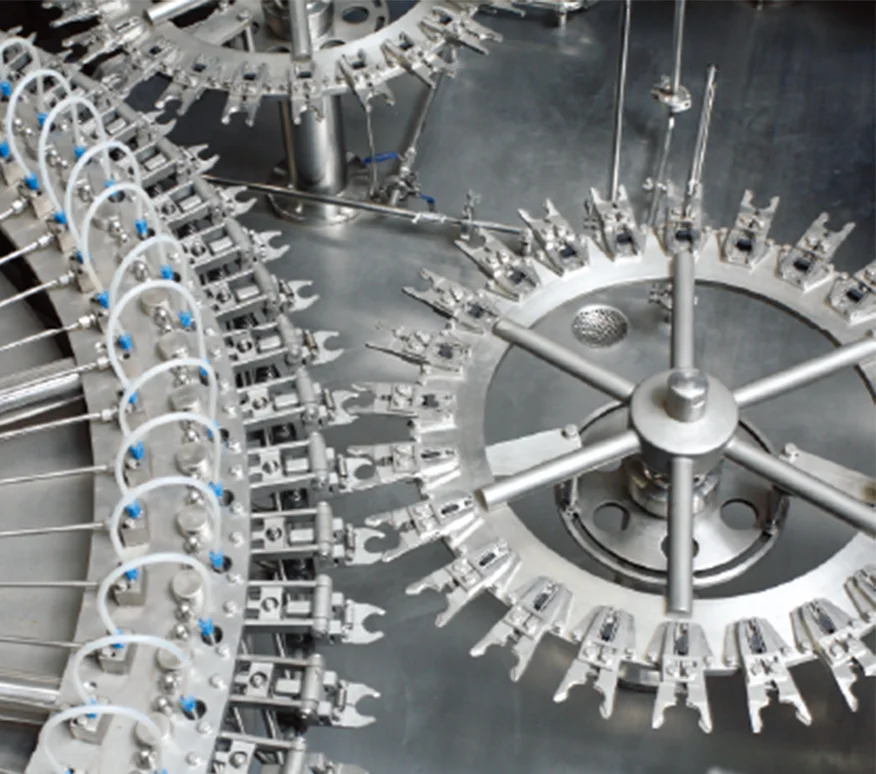
One rinsing turret or two: reading XGF and XXGF model codes
On ASG’s XGF and XXGF bottled drinking water filling line specification table, nine models cover 5,000 to 42,000 BPH based on a 500 mL PET bottle. Look closely at the head counts. The smallest unit, XGF14/12/5 (5,000 BPH, 2.2 kW), has a single 14-head rinsing turret (listed as Washing Heads 1) ahead of 12 filling heads and 5 capping heads. Every larger frame from X(X)GF16/16/5 (8,000 BPH) up to X(X)GF80/80/22 (42,000 BPH) lists both Washing Heads 1 and Washing Heads 2, from 16 to 80 heads per turret.
That parenthetical “X(X)GF” code covers two different machine builds. An XGF monoblock carries one rinsing turret; an XXGF block carries two rinsing turrets in series before the filler. If a proforma invoice writes “X(X)GF32/32/8” without dropping the parentheses, you cannot tell from the model code alone whether you are buying one 32-head rinser or two.
Which build makes sense depends on how empty bottles enter your hall:
- Single-stage rinsing (XGF): Common when PET preforms are blown in-house and travel straight into the filler through a covered air conveyor, so the rinser’s job is a single internal flush with treated product water to clear static dust.
- Two-stage washing and rinsing (XXGF): Used when empty bottles come from bagged warehouse stock or external transport, or when quality rules require a disinfectant wash on the first turret followed by a clean product-water rinse on the second.
If your plant plans to run ozonated water, peracetic acid, or chlorine dioxide on a turret, put the exact concentration and temperature in the RFQ. Ask the supplier to name the stainless grade and seal materials on every wetted manifold, rotary union, nozzle, and catch pan rather than relying on a generic “stainless steel” line item. For broader line sizing across bottle formats, see the water filling machine buying guide.
Piping, pressure, and drains between water treatment and the monoblock
ASG lists its water treatment system as a separate package from its filling machines. Even when you buy both from one supplier, the pipe run between the treated-water tank and the rinser inlet has several items that routinely fall into a gray zone during installation: the dedicated rinse supply pump, the terminal cartridge filter right before the rotary manifold, pressure switches, and drain piping.
Keep continuous bottle rinsing separate from stationary pipework cleaning in your project documents as well. CIP circulates cleaning solutions through the filler bowl, valves, and product supply lines while production is stopped; it does not feed or drain the empty-bottle rinser during bottling. We covered that boundary in the bottled water CIP scope guide.
Sending a short four-row boundary table with your RFQ forces every bidder to price the same hardware:
| Scope boundary | What to write into the RFQ | What to check before sign-off |
|---|---|---|
| Turret build and media | Specify XGF (1 turret) or XXGF (2 turrets), head count per turret, and the exact liquid or gas on each stage. | General arrangement drawing, itemized quote line, and wetted-parts material list. |
| Rinse water feed | Flange or tri-clamp tie-in location, required flow and pressure at rated BPH, and who supplies the booster pump and final filter. | Tagged P&ID or piping sketch, pressure sensor location, and low-pressure machine alarm behavior. |
| Neck grippers and jet shutoff | Full set of bottle drawings, neck finishes, empty gram weights, plus automatic spray shutoff on missing bottles or line stops. | Live run with lightest and tallest bottles; verify valves close when a pocket is empty or the line halts. |
| Drain routing and carryover | Piped drain manifold vs open floor discharge, separation of stage-1 chemical return from stage-2 water drain, and max residual water. | Drain connection drawing, splash-guard check between turrets, and weighed residual-water log. |
Checking nozzle alignment and residual water on lightweight PET
Thin-walled 330 mL and 500 mL water bottles hang by their neck ring through the rinser. On a fast line, two small mechanical faults cause most commissioning headaches. First, if a gripper spring or cam pinches a lightweight neck too hard (or wears loose), the bottle mouth tilts slightly off center and the water jet hits the threads instead of flushing the bottom of the bottle. Second, if jet pressure is turned up without matching the drain cam arc, lightweight bottles either lift on the nozzle or carry too much rinse water into the filler.
Leftover rinse water matters more than many first-time buyers expect. On mineralized or flavored water lines, inconsistent water left in the bottle shifts mineral dosing and net fill height. On two-stage XXGF lines using a chemical first stage, poor draining between Washing Heads 1 and Washing Heads 2 carries sanitizer into the final water rinse. Deep petaloid bottle bases also trap more droplets on the inverted drain track than flat bases.
Do not rely on watching bottles blur past a window to judge draining. Put a quick scale check into your acceptance run. For example, you can number 60 dry 500 mL bottles with a marker, weigh them empty on a bench scale, run them through the rinser at rated BPH with the filling valves shut off, and pull them at the filler transfer starwheel to weigh again. Suppose 58 bottles come off holding 0.25 g of water or less, while two bottles come off with 0.85 g and wet outer threads. Matching the bottle numbers back to numbered rinser clamps tells the technician which two heads have a bent nozzle or sticky gripper before the machine is crated. Those gram numbers are just an example of how to run the logbook; set the actual pass/fail weight with the supplier for your bottle geometry and product.
Splitting factory tests (FAT) from site commissioning (SAT)
A factory test in the builder’s workshop cannot prove your plant’s water microbiology, and site commissioning is the wrong time to discover that a tall 1.5 L bottle scrapes a drip tray. Split the two checklists cleanly in the purchase contract.
During the factory acceptance test (FAT), bring enough preforms or blown bottles of every contracted format, including both your lightest short bottle and your tallest bottle, to run a continuous mechanical and wet test. Check neck-ring transfer across every starwheel, confirm spray jets hit the center of the inverted base, pull an emergency stop and simulate a downstream jam to make sure rinse valves shut off instead of flooding hanging bottles, and run the numbered dry-versus-wet weight check.
Once the machine is anchored at your plant (SAT), verify steady rinse supply pressure while both the rinser and filler run at full speed, check that stage-1 and stage-2 drains discharge cleanly without backing up onto the floor, and let your lab run its chemical-residue and microbiological release tests under normal plant SOPs. If you already have bottle drawings and a target line speed, send ASG your bottle drawings, rinse media, and target BPH for an itemized quote.
Buyer questions on water bottle rinsing
Does an X(X)GF model number include two rinsing turrets by default?
No. On ASG’s specification sheet, X(X)GF marks frame sizes that can be built either with a single rinsing turret (XGF, Washing Heads 1 only) or with two turrets in series (XXGF, Washing Heads 1 and Washing Heads 2), while XGF14/12/5 is built only as a single 14-head rinser. Always ask the supplier to write XGF or XXGF explicitly on the quote and list the head count per turret.
Does a filler CIP package clean or feed the empty-bottle rinser?
No. A CIP circuit cleans the product tank, filling valves, and product piping when bottling stops. The bottle rinser sprays incoming empty PET bottles during production and needs its own treated-water feed, final filter, and drain tie-in defined on the piping drawing.
What changes on the rinser when one machine runs 330 mL, 500 mL, and 1.5 L bottles?
Sharing the same neck finish avoids changing the machine’s working height, but bottle diameter, height, weight, and base shape still change how containers swing in the clamps and how fast water drains out. Send drawings and physical samples of every bottle size so the quote lists all starwheel and neck-guide change parts and tests both the smallest and largest bottles at FAT.
What details should we include in an RFQ for a water bottling machine?
Include your water type (pure, mineralized, or spring water), required hourly output in BPH, bottle drawings with neck finish and gram weight for each format, how empty bottles arrive at the machine (direct from a blow molder or from storage), any sanitizer planned for rinsing, and your available treated-water pressure and floor drain setup.